
How Treasury Teams Should Think About AI for Data Analysis
By Cooper Strout, Lead Data Architect at Treasury4
For as long as treasury has existed, the workflow has moved in one direction. Analysts gather data, organize it, and send it up the chain so that somebody more senior can try to figure out what it means.
AI is about to collapse that entire sequence.
The gathering and organizing is getting automated, and the interpretation layer, where someone looks at the numbers and decides what to do next, is becoming the primary job rather than the last step after the grunt work. Whether your AI can support that shift depends almost entirely on an architectural decision sitting underneath it, one that most treasury teams have never been asked to make.
The Question Behind the Question
When we first released the Treasury4 MCP Server, the pattern was immediate. Every user asked some version of the same thing: what is my cash position, and what are my current balances? They were trying to replicate the reports they already had, just faster, and that makes sense as the obvious first move.
But the real value showed up when people started asking things nobody had built a dashboard for. They wanted to know which entity was dragging down forecasted collections, whether the momentum was slowing or accelerating, and when they needed to pick up the phone and ask a counterpart if they needed help.
Those are not report questions. They are reasoning questions, and the ability to answer them comes down to how your data layer is built.
Two Architectures, Two Different Jobs
There are two primary approaches to enabling AI for treasury data analysis, and both execute queries and return answers. The difference is how much thinking the AI is permitted to do.
The Semantic Layer Approach
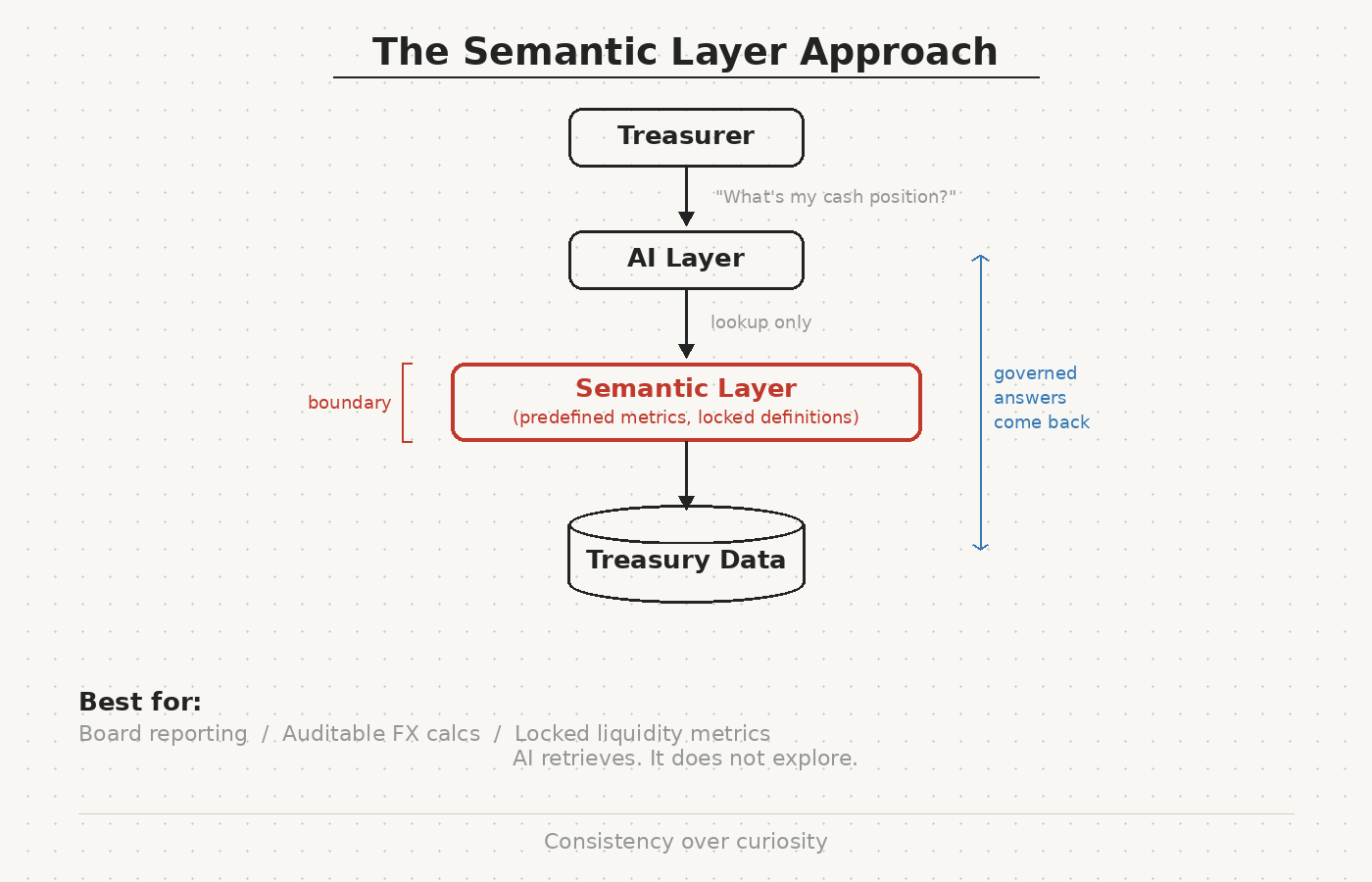
In this model, business logic lives in a defined layer above the data, and metrics are locked in advance. This is how we calculate FX exposure, this is how cash position is reported, this is how revenue is defined across entities.
The AI queries against those predefined definitions and returns answers, but it retrieves rather than explores. The result is consistency: outputs are governed, definitions are auditable, and answers are repeatable. For board-level reporting, regulatory obligations, or any metric that needs to read the same way every single time, that structure is the entire point.
The Model-Plus-AI-Analyst Approach
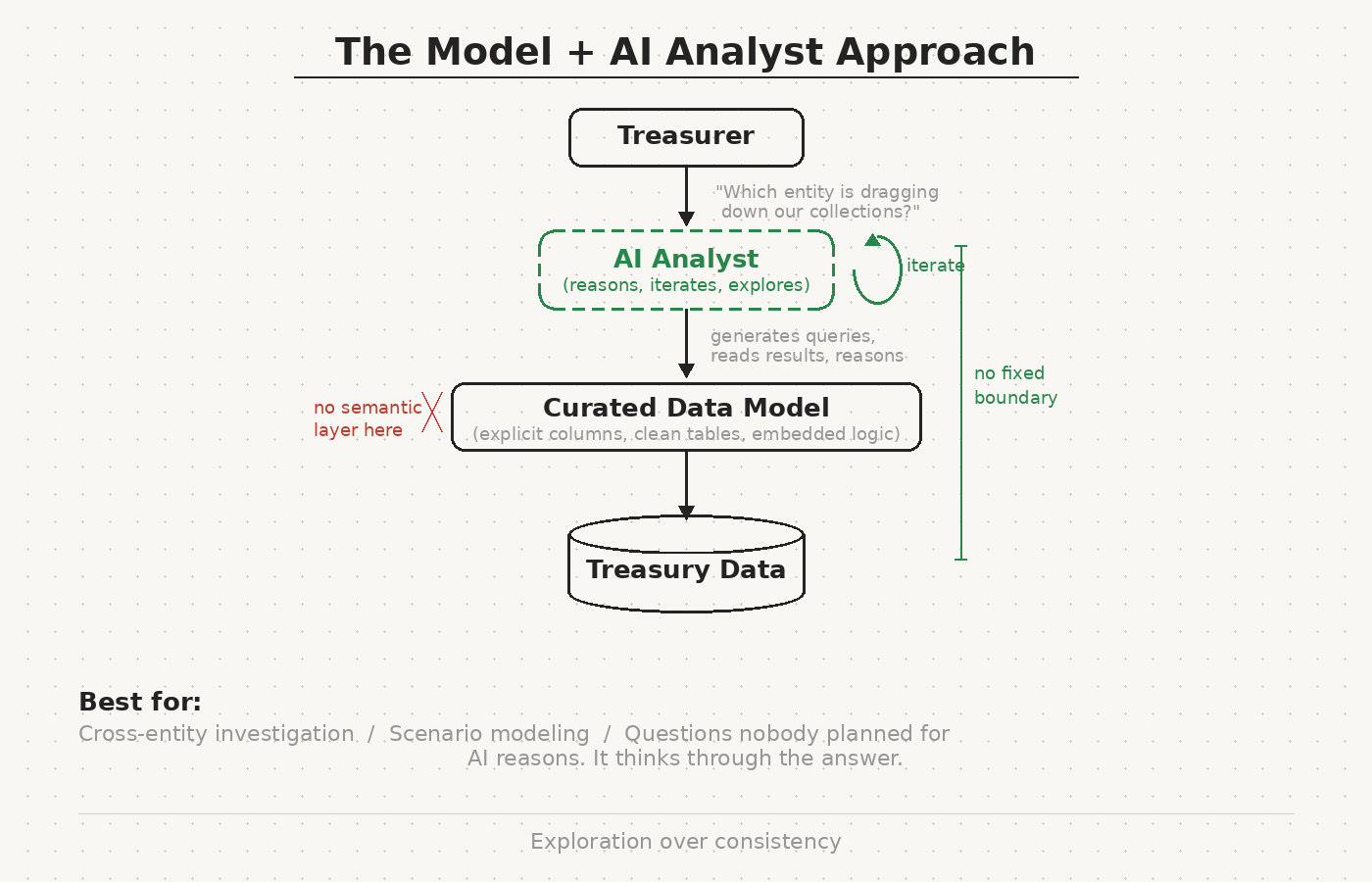
In this model, business logic is embedded directly into the data itself through curated tables, explicit column definitions, and clean transformations. The AI generates queries, reads the results, reasons about what it finds, and iterates when something does not add up.
The AI is not just retrieving here; it is thinking. This gives you exploration: the ability to do scenario planning, investigate discrepancies across entities or systems, and answer the questions nobody anticipated when the data model was built.
The Distinction That Matters
Both approaches work, and the mistake is applying the right one to the wrong job.
Semantic layer tools draw a boundary around what the AI can explore, and that boundary produces governance. AI analyst tools push that boundary outward, and that expansion produces insight.
Treasury needs both because a collections pacing analysis across 30 entities does not belong in the same architecture as your auditable daily cash position. One requires the AI to reason through complexity, and the other requires the AI to stay in its lane.
Why "Just Use AI With My Spreadsheets" Does Not Scale
There is a tempting shortcut: take the AI tools you already have access to, point them at your existing spreadsheets, and skip the infrastructure question entirely.
You can reach 100% cash visibility in spreadsheets, and people have done it, but you cannot scale anything from there. The moment you need audit trails, user permissions, security gating around who can see which accounts, or any form of controlled access, a duct-taped setup falls apart.
If you can now do anything you want with AI, the real question becomes whether you should. You should not be building your own treasury management system inside a spreadsheet, no matter how powerful the AI layer is, because there are too many infrastructure and security concerns that have nothing to do with analytics. The untapped potential is in getting more insight out of your data and getting more people in your organization to act on it, not in rebuilding plumbing.
Where Each Approach Belongs
Semantic layer tools belong where governance is non-negotiable: standardized board reporting, auditable FX calculations, and defined liquidity metrics that need to read the same way every time.
AI analyst tools belong where the question has not been asked before: cross-system reconciliation, scenario modeling, predictive analytics, and identifying patterns across entities, currencies, or time horizons that no dashboard was ever designed for. These tools help you understand what the numbers mean, not just what the numbers are.

The Bigger Picture
Treasury teams are sitting on some of the most complex, high-stakes financial data in the enterprise. For a long time, the treasury technology available was not sophisticated enough to do much with it beyond reporting.
That has changed.
AI models today can generate queries, interpret results, validate outputs, and reason across systems in ways that were not practical two years ago. The teams that build the right architecture around that capability are not just going to report faster. They are going to understand their business in ways that were not previously possible.
Business logic in the data model. AI that can reason over real outputs. Governed metrics where consistency is required. Each layer doing a specific job.
That is the stack that transforms treasury from a reporting function into a true center of analytical intelligence.
Cooper Strout is the Lead Data Architect at Treasury4 who started his career as a Treasury Analyst at Itron, where he automated treasury operations using SQL and Power BI. That hands-on treasury experience now informs his work building Snowflake data pipelines, the Treasury4 MCP integration, and AI-driven workflows that put analytical power directly in the hands of treasury professionals. He trains teams on coupling AI tools with sound data practices to move beyond traditional BI bottlenecks.