
How Do You Trust AI When Every Answer is Different

By Ty Heim, AI Engineer at Treasury4
Every time I ask AI a question, the answer is different.
This is a universal frustration, and I see treasury teams hit it constantly. You ask for yesterday's consolidated cash position across three entities and get a clean summary. Ask the same question the next morning, phrased slightly differently, and the format changes. The numbers are right, but one day it calls it "net cash" and the next it says "ending balance." For a treasurer managing liquidity across dozens of entities, multiple currencies, and a web of intercompany flows, that inconsistency is not a minor annoyance. It is a trust problem.
Luckily, there are a few ways around it once you understand what your AI is actually doing under the hood. So here is what you need to know.
AI Is an Equation Mixed with a Roll of the Dice
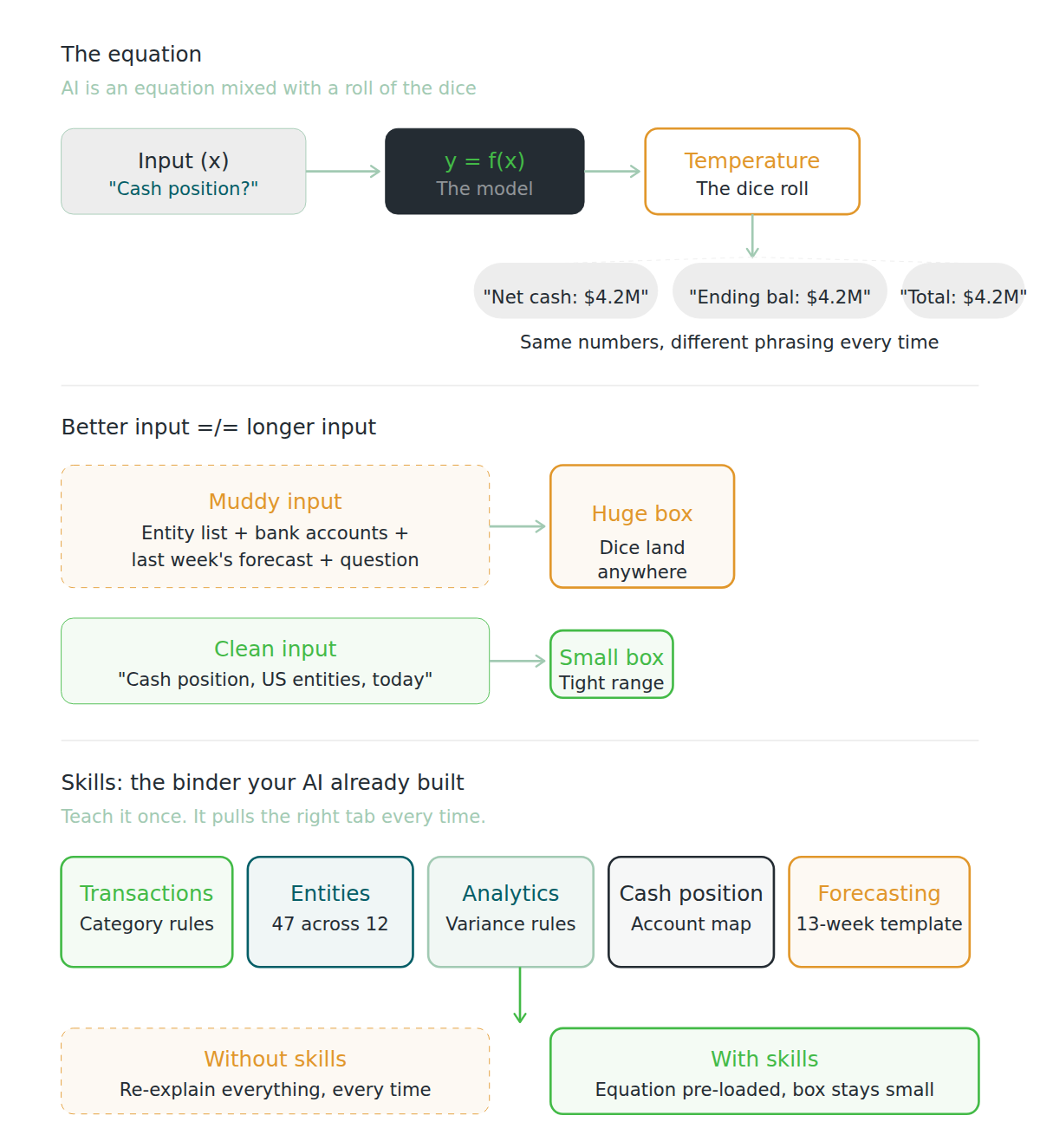
If I give you an equation of "y = 2x" and an input of "x = 3," you use that input to get an output of "y = 6." If I tell an AI "the sky is ______," it is likely going to say "blue." There is the equation: input to output.
I say "likely" because of the roll of the dice. Based on what the AI has trained on, its equation might spit out other things it has seen: "cloudy," "clear," "black," each with a probability that it would be the next word. The roll of the dice picks which answer it shows you.
This is called temperature. Lower temperature means pick the most likely answer. Higher gives it some wiggle room to choose other likely options. Most AI models sit somewhere in the middle. That is why you get different answers each time.
Now translate that to treasury. When you ask for a variance explanation on your daily cash position, the AI has a range of plausible ways to phrase the answer. It might attribute a $2M swing to "timing differences in AP settlement" or "delayed vendor disbursements" or "a payables processing lag." All reasonable. All slightly different. The dice are rolling.
But remember, there are two parts to this process. The input to the equation is how we shrink the box the dice roll in.
Better Input Does Not Mean Longer Input
This is where treasury teams get tripped up. The instinct is to dump everything: paste in the full entity hierarchy, the bank account list, every transaction category rule, last week's forecast, and then ask the question. But if I tell my AI my grocery list, my favorite planet, and what grade I learned about the solar system, then ask it what color the sky is, I have made my input muddy.
The same thing happens when you front-load a cash position query with every piece of context your treasury has ever produced. You are not giving the AI a cleaner x. You are giving it "x = ((12 x 4) - 18) / (2 + 3) x (7 - 6) + (9 / 3) - 9 + (6 x 0.5)." It might still get to 6. But you have made it harder, not easier.
Better input means cleaner input. SO better input does not equal longer input.
Four Tricks for Better Input (Treasury Edition)
Use examples. If I show you "y = 6 when x = 3" and "y = 10 when x = 5," you will figure out the equation way faster than if I describe it in a paragraph. Same with AI. Show it two or three examples of the answer you want and it will lock onto the shape.
In treasury terms: if you want your daily liquidity summary formatted a specific way, do not describe the format in three paragraphs. Paste in two previous summaries that looked the way you want. Show it "when the input is Tuesday's bank balances, the output looks like this." The AI locks onto the structure immediately. Works extremely well.
Ask for structure. Numbered list. Table. Bullets. Currency and entity as column headers. You are basically telling the AI "y has to look like this" before it even solves for it. Smaller box, fewer places for the dice to land.
For a 13-week cash forecast summary, tell the AI the output is a table with weeks as columns, operating cash and restricted cash as rows, and variances calculated week-over-week. Now the dice are only rolling on the narrative, not the structure.
Re-roll on purpose. Answer is off? Regenerate. The equation is the same, the input is the same, you are just rolling the dice again. Faster than rewriting your prompt half the time. If the AI gives you a cash forecast variance analysis that reads awkwardly but the numbers are sound, hit regenerate. You will get a different phrasing with the same underlying logic.
Use skills. This is the big one, and it is where the trust problem actually gets solved for treasury.
Skills: The Binder Your AI Already Built
Think about how you would actually learn something. You sit through the lecture once, take notes, and shove them in a binder with tabs. Next time the topic comes up, you do not re-attend the whole lecture. You flip to the tab.
Skills work the same way. You teach the AI something once, it writes the notes, you file them under a tab. Next time you ask about that topic, it flips straight to those notes before answering. No re-explaining. No muddy input.
For treasury, this changes everything. Here is why.
Transaction categorization. Every treasury team has its own logic for how transactions get bucketed. Payroll runs, intercompany transfers, vendor disbursements, tax payments, debt service, dividend distributions. Without a skill, the AI might label the same wire as "operating outflow" one day and "corporate disbursement" the next. You teach it your categorization rules once: what counts as operating, what counts as financing, how intercompany transfers get tagged, which transaction descriptions map to which buckets. That becomes a skill. Every future classification uses those rules. The dice are still rolling on phrasing. They are not rolling on where a transaction lands.
Entity management. You have 47 legal entities across 12 jurisdictions. Some are dormant. Some have intercompany lending agreements. Some sit in tax jurisdictions with specific reporting requirements. A skill captures the full hierarchy: which subsidiaries roll up to which regions, which entities are active versus dormant, what the ownership chain looks like. When you ask "what is our exposure to the UK," the AI pulls the right subsidiaries without guessing. It does not confuse the holding company with the operating entity. It does not include the dormant shell you wound down last quarter. Every time.
Analytics and variance analysis. When your CFO asks why cash was down $3M versus forecast, the AI needs to decompose the variance the way your team does internally. Not a generic "revenue was lower than expected." A skill teaches the AI your variance framework: timing differences versus permanent misses, operating versus non-operating drivers, which entities typically cause forecast drift, and what level of detail the leadership team expects. The analysis stays structured. The narrative adapts to what actually happened that week.
Cash positioning. You teach the AI your account structure once: which bank accounts are operating versus restricted, how intercompany balances net out, which accounts sweep overnight, and what your reporting currency is for consolidation. That becomes a skill. It does not need to be reminded that your UK subsidiary reports in GBP but consolidates in USD. It does not guess which accounts are restricted. It does not call it "net cash" on Monday and "ending balance" on Tuesday. The tab is already pulled.
Cash forecasting. Your 13-week forecast has a specific structure: direct method, rolling weekly, with operating receipts and disbursements broken out by category. You teach the AI the forecast template, the category definitions, and the variance thresholds that trigger commentary. Now when you ask for a forecast update, the output matches the structure your team already uses. It does not invent new line items. It does not merge categories you keep separate. It does not drift from the format your board has seen for the last four quarters.
You are not re-lecturing every conversation. You are handing the AI a binder it already built, with the right tab pulled. Equation pre-loaded. Dice rolling in a smaller box, in the right area, every time.
What This Means for Treasury Teams
The trust problem is real. But it is solvable once you stop thinking of AI as a person who should know things and start thinking of it as an equation with a randomizer attached.
Your job is not to tell it everything every time. It is to give it a clean x and let it solve. Skills are how you make that x clean permanently, not just for one conversation, but for every conversation that touches that part of your treasury operation.
The variability does not disappear. The AI will still phrase things differently each time. But it will phrase them differently within the guardrails you set: the right entity names, the right transaction categories, the right account classifications, the right forecast structure. The structure holds. The commentary flexes.
One skill for transaction categorization. One for entity management. One for analytics. One for cash positioning. One for cash forecasting. Build five and you have a system that operates with the institutional knowledge of your most experienced team member, available to everyone, every day, without the bottleneck.
Every answer is still different. But now, every answer is reliably yours.
Ty Heim is an AI Engineer at Treasury4 who cares as much about helping people understand AI as she does about building with it. She joined as a data intern while finishing her mathematics and computer science degrees. Her love of nonlinear dynamics and chaos theory pointed her toward machine learning. From there, her path moved through reporting, data, and software development before landing in AI engineering. Today she shapes internal AI use at Treasury4 and teaches others about it: what it really does, how to use it well, and why it was never as out of reach as it has been made to feel.